04.06.2026
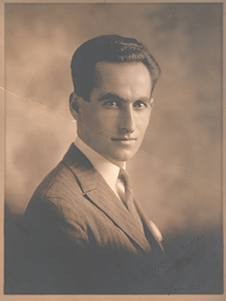
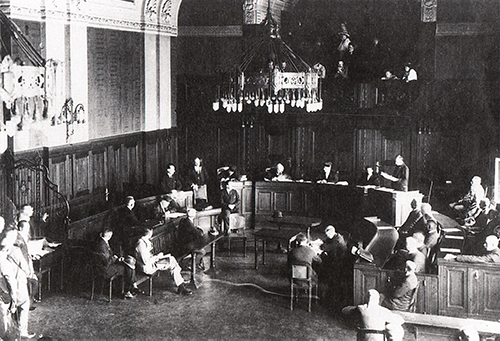
On June 2-3, 1921, the trial of Soghomon Tehlirian took place at the Moabit District Court in Berlin; it lasted only one and a half days instead of the scheduled three.
Tehlirian was defended in court by three prominent German lawyers: Secret Privy Councilor of Justice Dr. Adolf von Gordon, his colleague Dr. Johannes Werthauer, and Dr. Professor Niemeyer, a lecturer in criminal law at the Faculty of Law at Kiel University. Present in the courtroom were not only representatives of the Armenian community in Berlin but also Turks representing the murdered Talat, including Talat's wife, Hayriye Hanum.
To establish Talat's guilt, the defense lawyers used original telegrams from the time, in which the former Turkish Minister of Internal Affairs gave orders for the extermination and deportation of Armenians. These were presented to the German court by Aram Andonian. During the trial, testimonies were given by high-ranking German officer Liman von Sanders, the famous public figure and Armenophile Johannes Lepsius, and Armenian survivors of the genocide, including Grigoris Balakian.
From a legal standpoint, Tehlirian's defense was based on Article 51 of the German Penal Code, which stated: "There is no punishable act if, at the time of the act, the perpetrator was in a state of unconsciousness or had a pathological disturbance of mental activity, due to which his expression of will was excluded." On June 3, 1921, by the verdict of the jury, S. Tehlirian was found not guilty and released.
The trial of S. Tehlirian had a significant socio-political impact; it was widely covered in the European, American, and Armenian press of the time, as well as by German and Turkish journalists.
Tehlirian's assassination of Talat is the most famous operation of the "Special Case" (Operation Nemesis).
Photo: Soghomon Tehlirian, June 1922. "Armenian Genocide Museum-Institute" Foundation, donor: Anush Ohanian-Oskanian.
Gohar Khanumyan
Chief Curator at AGMI