19.12.2025
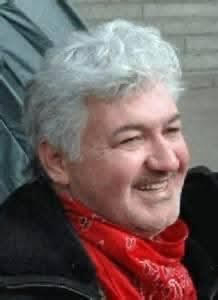
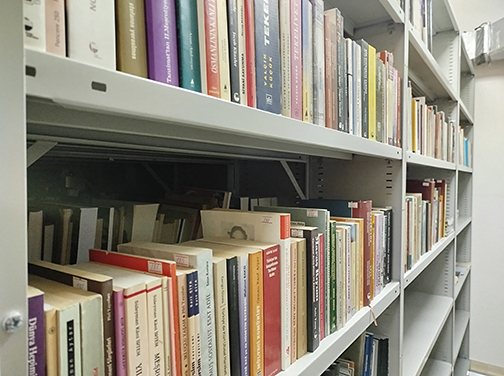
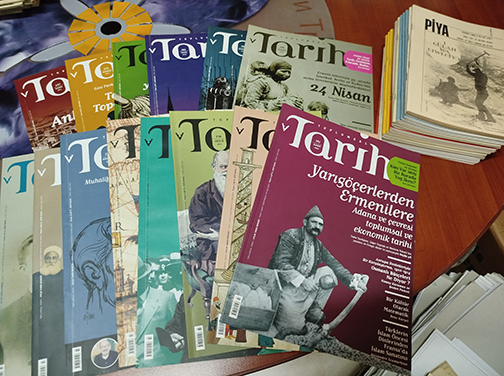
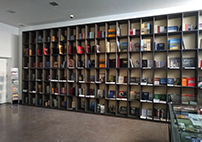
357 valuable books belonging to Sargis Hatspanian have taken their rightful place in the AGMI scientific library. Registered as the "Sargis Hatspanian Personal Library," they have enriched the Institute's scientific collection, becoming not only a resource for scientific research but also a part of memory.
This donation is valuable not only from the perspective of the content of the books but also because this unique collection, meticulously formed during the long years of research and search by Sargis Hatspanian—a descendant of Armenian Genocide survivors—is being passed on to the Armenian Genocide Museum-Institute.
The AGMI Foundation expresses its deep gratitude to Sargis Hatspanian's family, particularly his wife, Hasmik Poghosyan, for entrusting us with this valuable part of their family library.
This donation is a continuation of Sargis Hatspanian's memory; a bridge between the spiritual heritage of his survivor family, the testimonies of the past, and our scientific mission.
The Family History of the Hatspanians Who Passed Through the Crossroads of Genocide
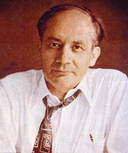
Sargis Hatspanian was the youngest of the five children of Mariam Evigyulu and Gevorg Ekmekchi (Ekmekchioglu).
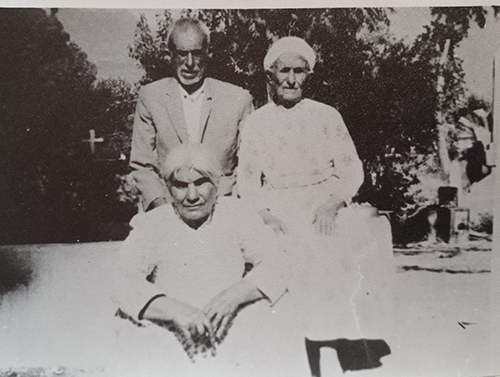
Maternal Grandmother: Hripsime (Horom) (1910/11–1989) was the sole survivor of her clan. In 1915, at the age of four, she witnessed a Turkish soldier kill her father with a sword in Adiyaman, after which he wanted to forcibly take her pregnant mother as a wife. After the woman scornfully refused, replying, "I will never exchange my horse for a donkey," the enraged soldier slaughtered her.
The orphaned Hripsime was taken and raised by a Kurdish family. Later, relatives who returned to Adiyaman went to find the child based on memories and asked the Kurdish family to return her. However, the Kurds refused, saying they had raised her for so many years to serve them. Only after rumors spread in the provinces that families keeping Armenian orphans in Muslim households were required to hand them over to the Turkish government or orphanages, or else be punished, were the Kurds forced to return Hripsime to her relatives.
Later, Hripsime married Akob (Hakob) Evigyulu. They had seven children, one of whom was Mariam Evigyulu Ekmekchi (1932–2018), Sargis's mother.
Maternal Grandfather: Akob (Hakob) Evigyulu (1891–1970) was forced to flee to the mountains during the Armenian Genocide to avoid exile, living in hideouts and uncertainty for years. After the danger relatively subsided, he returned to his birthplace, Adiyaman, where he tried to rebuild his life and started a new family by marrying Hripsime.
Paternal Grandmother: Araksi (surname unknown) (1908–1978) survived the genocide with great difficulty; her family members were exiled in different directions. After some time, she also returned to Adiyaman.
Paternal Grandfather: Tserun Hatspanian (1910–1964) was exiled to Der Zor at the age of 6-7 with his two older sisters, Mariam and Khanum. The sisters had already lost their husbands and children and managed to save their little brother by disguising him in girls' clothing. They were the only survivors of their large clan.
After surviving for a few years doing hard labor among Arabs, they returned to Adiyaman in 1920, when the Sanjak of Alexandretta came under the French mandate within Syria. They found the Armenian quarters and the church completely destroyed. According to family history, their lands and orchards were misappropriated by "a certain Assyrian Toros Agha," and they were unable to reclaim them, starting life from scratch and forming families.
All the returned Armenians were forced to live in the Assyrian quarter because it had not been damaged during the genocide years, and they performed their church ceremonies in the Assyrian church.
Tserun married Araksi in 1926 or 1928. One of their seven children, Gevorg Ekmekchi (1930–2010), was Sargis's father, who married Mariam Evigyulu in Adiyaman in 1947.
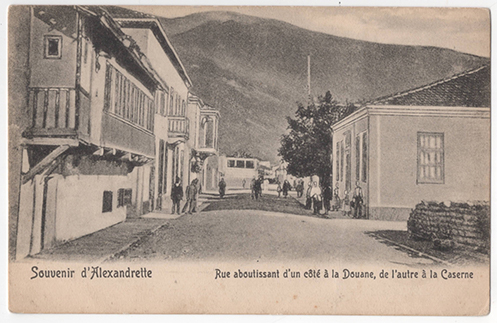
In 1960, Gevorg Ekmekchi was forced to move with his wife and four children to Alexandretta (Iskenderun) for the family's safety, after Kurds began threatening his family members because he had brought back an Armenian girl who had been abducted by them.
Sargis Hatspanian, as he writes himself, was born on February 12, 1962, in the beautiful coastal city of Alexandretta in Armenian Cilicia. Armenians living in the provinces who were eager for their children to receive an Armenian education were often forced to send them to Constantinople (Istanbul) from a young age. Six-year-old Sargis was one of those children; he left his paternal home, more than a thousand kilometers away, to study at the Karagyozyan Orphanage-School in Constantinople (1968–1973), and then continued his education at the Surp Khach Tbrevank (1973–1979). Sargis returned to his paternal home in Alexandretta only during summer vacations, which he often spent with his uncle's family in the village of Vakif (Vakıflı) on Musa Dagh—the only remaining Armenian village in Turkey.
In 1979-1980, he studied at the Cinema Department of the State Academy of Fine Arts in Constantinople. In 1979, he published numerous articles in Turkish and Armenian newspapers dedicated to Western Armenia, Cilicia, and the Armenian Question, as well as poems and translations.
As a result of the military coup in Turkey in 1980, he was arrested twice for his views, after which he was forced to move to Germany. To continue his education, he studied at the Faculty of Cinema at the University of Cologne from 1980 to 1982. He enlivened life in the Armenian community and founded the first Armenian dance group. He delivered various lectures on Armenian history and the Armenian Genocide. He was one of the active organizers of the "April 24" demonstration in 1982, which brought him to the attention of the Turkish special services.
After the explosion at Ankara airport on August 7, 1982, one of the perpetrators of which was Levon Ekmekchian, the mere coincidence of surnames caused the Turkish authorities to persecute all Ekmekchians living in Turkey and Europe. After living in hiding for some time, Sargis decided to move to France and received political asylum in Marseille.
As a result of long bureaucratic processes in France, Sargis managed to restore his family surname, Hatspanian, which had been forcibly registered as the Turkified version "Ekmekcioglu" under the 1934 "Surname Law." From 1985 to 1988, he continued his education in Film Directing at the University of Aix-en-Provence, while also succeeding in the Faculty of Communication and Linguistics, graduating with two degrees in 1988. During those years, he also attended Armenian studies courses.
He moved to Paris and, from 1988 to 1990, studied and graduated from the Department of Cinematography and Audiovisual Studies at the Sorbonne University's Faculty of Arts, defending his thesis on "Armenian Identity through the Eyes of Sergei Parajanov in the Film Sayat Nova."
In Paris, he was actively involved in the life of the Armenian community and was one of the organizers of "April 24" events. He continued his political and social activities within the framework of various meetings, gatherings, and demonstrations. From the first day of the Karabakh Movement, he organized hundreds of initiatives and delivered lectures.
In 1988, Sargis and his friends founded the "Artsakh Aid" organization in Paris. He made appeals to help the homeland in Marseille, Lyon, Paris, Brussels, Amsterdam, Utrecht, and Almelo, emphasizing: "The efforts of unique individuals like me will not achieve much; the interesting vitality and activity of the entire Armenian people is what matters... apart from material aid, [we must] exert much more political-social, public Armenian pressure on the authorities of the countries where we live; we can do that. They are interested in the work of pushing them towards a definite Pan-Armenian position." He established connections with various organizations in Armenia to deliver military uniforms, medical supplies, and other necessary items to the homeland through Diaspora means.
In 1990, at the invitation of Sergei Parajanov, Sargis Hatspanian moved from France to Armenia. They had met in Paris when Sargis was studying at the Sorbonne, and Parajanov had proposed working together on his new film.
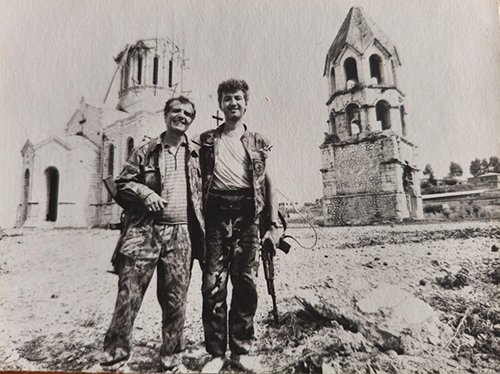
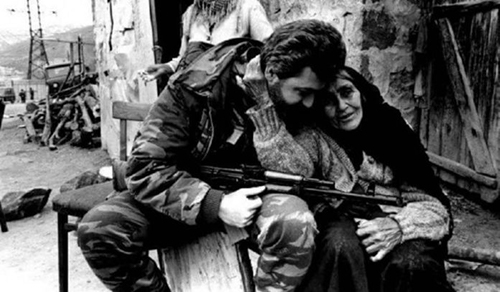
In the early 1990s, Sargis Hatspanian met Leonid Azgaldian and joined the Liberation Army founded by the latter's efforts in 1991, serving in combat operations in Martakert, Drmbon, Karvachar, and other regions both as a soldier and as a chronicler of the war, while simultaneously organizing and transferring humanitarian aid collected in the Diaspora. He accompanied delegations and individuals arriving in Artsakh from abroad, presenting the historical foundations and nuances of the Artsakh issue to the international community.
In 1993, a meeting between Armenian-American Varoujan Karian and Sargis Hatspanian had a profound effect on the latter. After returning to Los Angeles, inspired by Sargis's activities, Varoujan founded the "Hayrenik" Union charitable organization with friends to support the homeland; Sargis served as its representative in Armenia on a voluntary basis for about ten years.
Sargis Hatspanian was the representative in Armenia for a number of other charitable organizations (France, Belgium, Germany, Sweden). He would go door to door, seeing who needed what, writing everything down in detail, and then personally delivering the aid brought from the Diaspora to the people. He treated orphaned children with special care; he knew everyone's name and story. At the same time, he united and organized Armenians in the Diaspora who knew him to help Armenia.
Numerous programs were implemented with funding from the "Hayrenik" Union and through Sargis Hatspanian's organizational initiatives, including the renovation of the school named after the late Varoujan Karian in the village of Kusapat, Artsakh.
In 1995, Sargis married Hasmik Poghosyan in Armenia; they had two children, Mariam Arpi and Nairi Areg. For many years, he was the authorized representative of Kaytsak Zeytlian, a businessman from Musa Dagh and co-owner of the Jermuk Mother Factory. Parallel to his work, Sargis carried out active public activities: he published articles and made appearances on television. He regularly delivered lectures on Armenian history and the Armenian Question at the Narekatsi Art Institute and the National Academy of Sciences.
To fight a severe illness discovered suddenly, Sargis moved to Lyon. In the last days of his life, a representative of the Organization of Istanbul Armenians of America visited him at the hospital in Lyon, awarding him the "Hrant Dink" medal.
Sargis Hatspanian passed away on January 20, 2018, in a hospital in Lyon. He was buried at the "Yerablur" Military Pantheon.
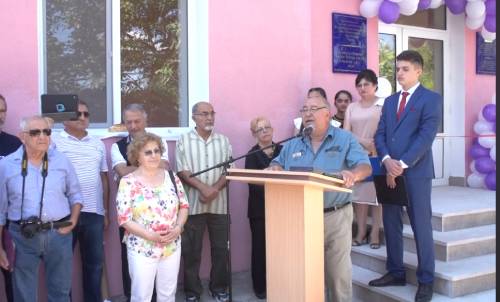
Sargis Hatspanian was posthumously awarded the "Vachagan Barepasht" medal of Artsakh and the medal of the same name by the "Fedayeen" organization. The Children's and Youth Creative Center in Martakert, built with funding from the "Hayrenik" Union, was named after Sargis Hatspanian.
Despite numerous difficulties, obstacles, periodic life-threatening dangers, and imprisonments, Sargis Hatspanian did not break, continuing his struggle for a better Armenia. Armenia was not a dream for him, but a daily task—the meaning and purpose of his life.
Sargis Hatspanian's biographical data are taken from his handwritten "Autobiography," provided to the AGMI by the Hatspanian family: Hasmik, Mariam, and Nairi.
Material prepared by AGMI Scientific Secretary, PhD in History Narine Margaryan.