Home Map E-mail
 
Eng |  Հայ |  Türk |   Рус  |  Fr  

Home
Main
Delegations
Site map
Feedback
Contacts
Links
Pre-Genocide Armenia
History of Armenia
Pre-Genocide photos
Armenian Genocide
What is Genocide
Armenian Genocide
Chronology
Photos of Armenian Genocide
Mapping Armenian Genocide
Cultural Genocide
Remember
Documents
American
British
German
Russian
French
Austrian
Turkish

Research
Bibliography
Survivors Stories
Eye-Witnesses
Media
Quotations
Public Lectures
Recognition
States
International organizations
Provincial governments
Public petitions
Mission Statement
Director`s message
Press-releases
Museum G-Brief
Interviews
News
Conferences
Events of AGMI
Year of Book new
Lemkin scholarship 
Most Read 
   Museum
Museum Info
Plan a visit
Permanent exhibition
Temporary exhibition
Online exhibition  
Memorial postcards  
   Institute
Goals & Endeavors
Publications
Journal  new
Library
AGMI collection
   Tsitsernakaberd Complex
Description and History
Memorial complex photos
Remembrance day
Friends of AGMI Foundation
 

Armenian General Benevolent Union
All Armenian Fund
National Academy of Sciences of Armenia
Public Radio of Armenia
Armenian News Agency
ARMEDIA  Information, Analytical Agency
Inhomage
armtown
armin
armin
armin
armin
armin


Permanent exhibition


The first exhibit hall of Armenian Genocide Museum
The Museum exhibition halls occupy a space just over 1000 square meters.
They are split up into three indoor halls and one outdoor gallery.

The western wall of the Museum's first exhibit hall has a map, nine meters wide and five meters high, engraved in stone, which illustrates the Armenian Plateau and neighboring countries. It clearly depicts Armenia being bordered by the Black Sea to the North, the Caspian Sea to the East, the Iranian Plateau to the South, and the Mediterranean Sea in the Southwest. The map also illustrates the Armenian settlements on the territory of Western Armenia and Ottoman Empire as they existed until the systematic death marches, which began in 1915.
The Introductory Hall exhibits photographs and demographic tables with information about the Armenian settlements and populations circa 1914 in Ottoman Turkey. The content also portrays information on the number of Armenian churches and schools which were functioning in the region at that time. Photo materials in exhibition tables present the peaceful life of Armenian population before Genocide.


The second exhibit hall of Armenian Genocide Museum
The second exhibit hall (700 square meters) presents eyewitness reports and documents about the massacres and atrocities perpetrated against the Armenians. The exhibit has many large photographs taken during 1915-1917, archival documents, portraits of prominent Armenians, victims of the atrocities, friends of the Armenian people, and documentary films.

The tables displayed in the third hall compare the Armenian population figures in 1914 and 1922 and also define the number of people deported and killed.

A special part of the exhibit is reserved for the original documents issued by international organizations and parliaments of foreign countries condemning the Armenian Genocide.
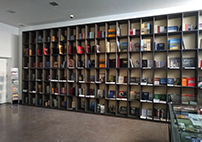
Various publications about the Armenian Genocide written in many languages are also exhibited here.
This hall also contains population data about the number of Armenians living in Europe, Asia, Africa, the Americas and Australia after the Genocide. In the same hall, granite pedestals support crystal vases which hold earth from historic Armenian regions: Karin (Erzerum), Van, Baghesh (Bitlis), Sebastia (Sivas), Kharpert and Tigranakert (Diarbekir). Here you will also find a granite tree with its branches spread symbolizing eternity and the rebirth of Armenian people.


The second exhibit hall of Armenian Genocide Museum
The last hall of the Museum is essentially an outdoor patio, a traditional feature found in old Armenian structures. A semicircular basalt wall, divided into twelve equal segments has enscribed statements condemning the Armenian Genocide by prominent foreign politicians, diplomats, scientists, and writers circa 1915. The hall looks like a courtroom where eyewitnesses “present” their condemning evidence.
The last word belongs to the visitor.


The third exhibit hall of Armenian Genocide Museum
There is also an art gallery, named after famous French-Armenian painter Jansem (Hovaness Semerjian) holds temporary exhibitions.


VIRTUAL MUSEUM

INTERNATIONAL CONFERENCE

genocide
Armenian Genocide:
Challenges on the Eve of Centenary

Ani plaza, Ani hall
Yerevan, March 22-23

TEMPORARY EXHIBITION

genocide
On April 23, 2012, AGMI presents a temporary exhibition titled “Book as a witness of the Genocide” dedicated to the 500th anniversary of the Armenian printing and proclamation of Yerevan as 2012 World Book Capital City by UNESCO. The temporary exhibition comprises more than 300 rare first editions and other sources on the subject of the Armenian Genocide.

SMYRNA DISASTER – 90

exhibition
In September 2012 AGMI presents a temporary exhibition dedicated to the 90th anniversary of “Smyrna disaster” – destruction of the Christian population of Smyrna, one of the major sea ports of the Asia Minor. The fire of Smyrna becomes one of the dramatic episodes of the Armenian genocide carried out this time by Kemalist forces in September 1922.

INTERNATIONAL JOURNAL OF ARMENIAN GENOCIDE STUDIES  

Interntional Journal of AGS

REMEMBER

remember
Aghababyan Levon was born in 1887 in Baghesh and graduated from the Sanasaryan College. From 1908 to 1914 he was first a teacher then a headmaster at the national colleges of Akshehir and Kutahya. He was a teacher of mathematics, opened a private school in Kutahya which worked for only three years and also was an editor of “Azatamart”. He was a victim of the Armenian Genocide.

LEMKIN SCHOLARSHIP  

Lemkin

EVENTS OF AGMI

April 9, 2013 The Russian delegation headed by the Chief of Staff of the RF Presidential Administration Sergei Ivanov, which is in Armenia on the occasion of the inauguration of the President of the Republic of Armenia Serzh Sargsyan, visited Tsitsernakaberd Memorial Complex and put flowers at the Memorial of the Armenian Genocide victims ...

December 18, 2012 The world known French actor Alain Delon visited Tsitsernakaberd Memorial Complex ...

November 24, 2012 The Deputy Speaker of the National Assembly of Bashkiria Raphayil Zinurov Tsitsernakaberd Memorial Complex ...

November 24, 2012 The Deputy Speaker of the National Assembly of Bashkiria Raphayil Zinurov Tsitsernakaberd Memorial Complex ...

September 25, 2012 Cardinal Kurt Koch, President of the Pontifical Council for Promoting Christian Unity, visited Tsitsernakaberd Memorial Complex. Cardinal Kurt Koch put flowers at the Eternal Fire and prayed for the repose of the victims’ souls...

June 15, 2012 The delegation of the Russian Institute of Strategic Studies (RISS), Moscow, headed by the director Leonid Reshetnikov and accompanied by Ruben Safrastyan...

May 1, 2012 Christos Malikkidas, the Permanent Secretary of Ministry of Defense of the Republic of Cyprus, visited Tsitsernakaberd Memorial Complex and put flowers at the Eternal...

April 24, 2012 Stephen W. Clark, Vice President, General Counsel and Secretary and Elizabeth Morrison, Acting Senior Curator of...

April 21, 2012 Minister of culture of Romania, Mr. Hunor Kelemen visited Tsitsernakaberd Memorial Complex...

April 17, 2012 A group of Turkish participants of USAID supported program on Turkish-Armenian dialogue...

RA, Yerevan 0028
Memorial Complex of Tsitsernakaberd
Tel.: (374 10) 39 09 81
Fax: (374 10) 39 10 41
    2007-2011 © Armenian Genocide Museum-Institute     e-mail : info@genocide-museum.am